
Astronomy · for new parents
Astronomy for Expecting Parents: 12 Night-Sky Tips for New Moms & Dads(and a keepsake of baby's first sky)
Astronomy PhD candidate developing balloon-borne VLBI telescopes for black hole research.
Published 2026-08-29 · 9 min read
The best astronomy tips for expecting parents are the ones that survive a newborn: learn three constellations before the due date, use the Moon as your calendar, treat night feeds as a 3 a.m. observing session, carry a red torch instead of a phone, and write down the exact time and place of the birth so you can keep that night's sky.
None of it needs a telescope, a dark-sky site or more than ten minutes at a time. The twelve tips below are ordered from pregnancy to first birthday; the last two are how to turn the night your child was born into something you can hang on the nursery wall.
Quick answers
For new moms
- Night feeds are dark-sky time: two minutes at the window, lights off.
- A red torch protects your night vision and their sleep.
- Counting full moons is an old, gentle way to count a pregnancy.
For new dads
- Learn Orion, the Big Dipper and Cassiopeia now; teach them later.
- Planets don't twinkle — that is how you tell Jupiter from a star.
- Write down the birth time and city. It is the whole keepsake.
01
Learn three constellations before the baby arrives
You will not have time to learn the sky afterwards, so learn a little of it now. Pick the three easiest patterns for your due season and find them once a week from the same window: in northern winter, Orion's belt (three stars in a short row); in spring, the Big Dipper high overhead; in summer, the Summer Triangle (Vega, Deneb and Altair, the three brightest stars up after dusk); in autumn, the W of Cassiopeia. Three is enough. Everything else hangs off them.
02
Spot the planets — they are the ones that don't twinkle
Stars twinkle because they are points of light shaken by our atmosphere; planets are tiny discs and shine steadily. If a very bright “star” low in the west after sunset holds still, it is almost certainly Venus. A bright, steady, pale-yellow point high in the sky is Jupiter. Note which planets are up during your due month; they will be on your baby's birth-night sky.
03
Use the Moon as a pregnancy calendar
A full-term pregnancy is about forty weeks, which is very close to thirteen and a half lunar cycles of 29.5 days. Note the phase on the night you found out, then watch it come round. Counting full moons is an older way of counting a pregnancy than counting weeks, and it gets you outside looking up once a month.
04
Night feeds are the best stargazing schedule you will ever have
The sky between 2 and 4 a.m. is the darkest and steadiest of the night, and the Earth has turned enough that you are looking at next season's constellations. The sky drifts 15 degrees west every hour, so a 3 a.m. feed in October shows you the January sky. Two minutes at the window with the lights off is a real observation.
05
Buy a red torch
Your eyes take twenty to thirty minutes to adapt fully to darkness, and one glance at a white phone screen resets the clock. Dim red light barely affects night vision — and it disturbs a sleeping baby far less than the overhead light. A red bike light or a torch with red film taped over it is enough.
06
Pin the meteor showers to the nursery calendar
Showers return on the same dates every year: the Quadrantids around 3–4 January, the Lyrids around 22 April, the Perseids around 12–13 August, the Geminids around 13–14 December. The Perseids and Geminids are the reliable ones. Lie back on a lounger with the baby wrapped against you and look roughly overhead; you do not need to find the radiant.
07
Find the North Star once, and you can find it forever
Take the two stars at the end of the Big Dipper's bowl and follow the line they make about five times their own separation: that is Polaris. It is not especially bright, but it does not move, and its height above the horizon equals your latitude. In the southern hemisphere, use the long axis of the Southern Cross instead.
08
Keep sessions short, keep the baby warm, skip the telescope
Ten minutes with a carrier and an extra layer is a stargazing session; do not plan an hour. You do not need a telescope for anything on this list. If you want one instrument, ordinary 7×50 binoculars show the Moon's craters, Jupiter's four big moons as a row of dots, and the Pleiades cluster — all steady enough to hold one-handed.
09
Put a printed star chart by the nursery window, not an app
Apps are excellent, and they are also a bright screen at 3 a.m. A printed chart for your month and latitude works with the lights off and never needs charging. Here is how to use a star chart in five steps.
10
Write down the exact time and place of the birth
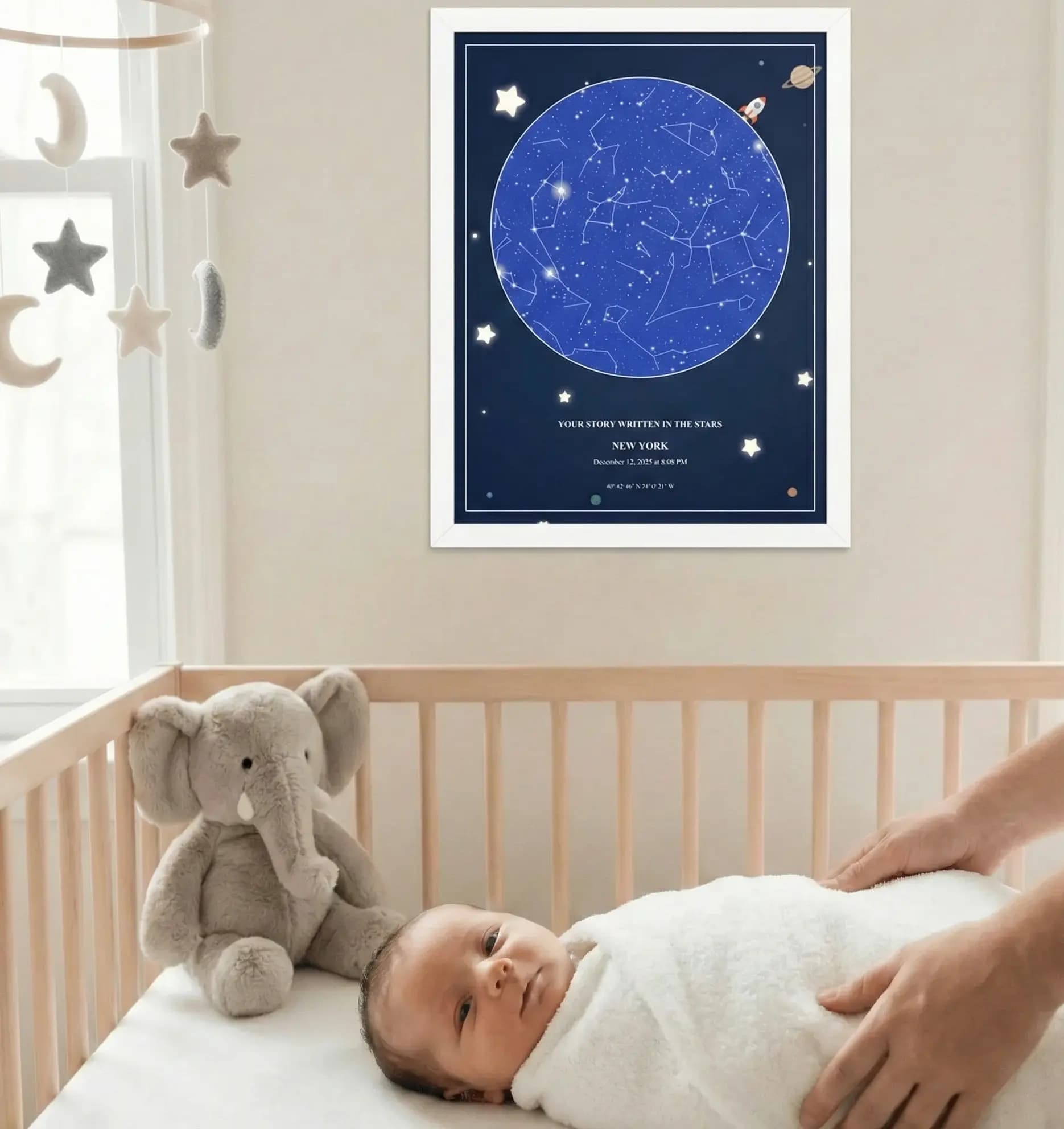
The sky is different from every point on Earth and changes minute by minute. Date, time and city are all it takes to reconstruct the exact arrangement of stars overhead at the moment your child arrived — and that arrangement will not repeat in your lifetime. Put it in the notes app before you forget.
11
Keep the birth-night sky
With those three details you can generate the real map of that sky: every visible star, the constellation lines, the Moon's phase and any planets, computed from a star catalogue for that timestamp and location. Ours is free to preview, $19.99 as a file, and printed and framed for the nursery with free shipping. It is the one piece of nursery art that is literally about them.
12
Make it a birthday tradition
Go outside on the same date every year and compare it with the birth-night map. The stars will not have moved — the constellations are the same for thousands of years — but the Moon will be in a different phase and the planets somewhere else. It is a small annual astronomy lesson, and by the time they are seven they will be the one finding Orion.
See the sky from the night your baby was born
Enter the birth date and city — the exact sky appears instantly, free.
Free instant preview · From $19.99 if you want to keep it
Questions
Frequently asked
- Is it safe to take a newborn outside to stargaze?
- For short sessions, dressed for the temperature, yes — the same judgement you would use for any evening walk. Keep it to ten minutes or so, use a carrier or wrap, avoid very cold or windy nights, and go back in the moment they are unsettled. If you have any doubt about your own baby, ask your midwife or paediatrician.
- What is the easiest thing to see with a baby in my arms?
- The Moon, then the bright planets (Venus after sunset, Jupiter high in the sky), then one anchor constellation for the season: Orion in winter, the Big Dipper in spring, the Summer Triangle in summer, Cassiopeia in autumn. None of these need dark skies or equipment.
- How can I find out what the sky looked like the night my baby was born?
- Enter the date, time and city into a star map generator that computes positions from a real star catalogue. Our customizer shows the full sky for that moment free, before you decide whether to buy the chart.
- Do I need a telescope?
- No. Everything in this guide is visible to the naked eye. If you want one instrument, 7×50 binoculars show the Moon’s craters, Jupiter’s moons and the Pleiades, and you can hold them one-handed.
The keepsake
A map of their first night sky
Every star that stood over the hospital at the minute they arrived, with the Moon's phase and any planets, computed by an astronomer's tools rather than drawn from a template. Free shipping on every print — no minimum, no surprises.
Keep reading