
How to Use a Star Chart to Read the Night Sky

Astronomy PhD candidate developing balloon-borne VLBI telescopes for black hole research.
Five steps to orient any star chart, find the constellations, and read what you are looking at — with a labelled example.
To use a star chart, hold it overhead with its North marker pointing north, find the centre (that is the sky directly above you), and match the biggest dots to the brightest stars you can see. The edge of the circle is your horizon, so anything near the rim sits low in the sky. Once one bright pattern matches, everything else falls into place along the constellation lines.
That is the whole method. The five steps below walk through it with a labelled example, and the rest of the guide covers what each element means, how sailors and pilots navigate by the same charts, and what the phrase “a star slips from its chart” means.
How to Use a Star Chart in 5 Steps
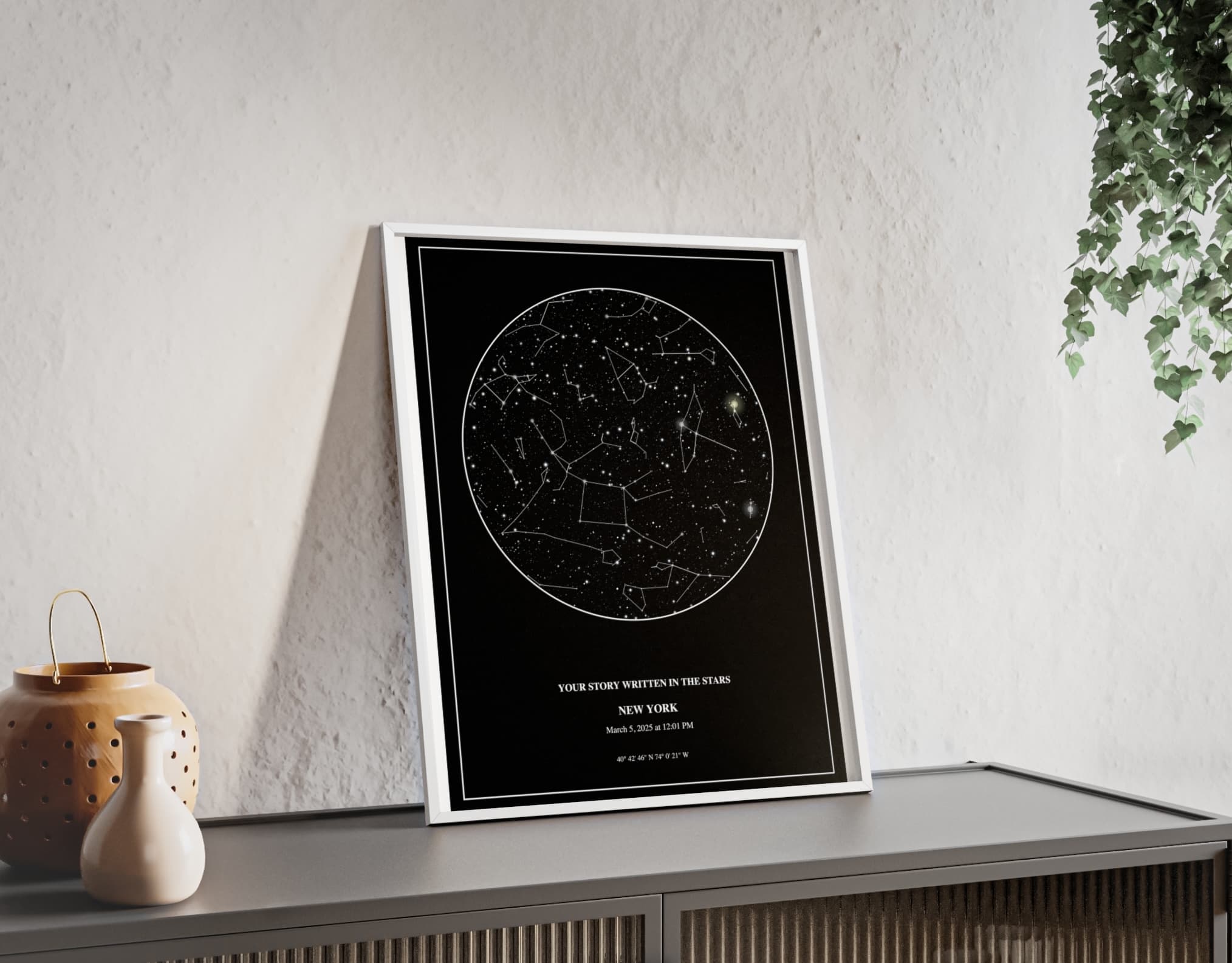
- 1Match the chart to your date, time and place
A star chart is only correct for one moment from one spot on Earth. Check the date, time and location printed on it (a personalised chart has them in the caption). Two hours later, or a thousand miles away, the sky has turned.
- 2Hold it overhead and point North to north
Face north (use a compass, or find Polaris with the Big Dipper), lift the chart above your head and rotate it until its N marker points that way. Now East on the chart is on your east side. Charts look mirrored when held in front of you like a book — that is why you hold them overhead.
- 3Start at the centre
The middle of the circle is the zenith, directly above you. Whatever is drawn there is the easiest to find: look straight up. Work outward from there; the edge of the circle is the horizon, where stars are faint, low and often hidden by buildings.
- 4Find one bright anchor, then follow the lines
Pick the largest dot near the centre, find that star in the sky, then use the constellation lines from it to trace the pattern. One confirmed match calibrates everything; do not try to identify faint stars first.
- 5Read brightness and spacing, not colour
Dot size is brightness (magnitude): the biggest dots are stars like Sirius and Vega, the smallest are at the limit of naked-eye vision. Judge distances by the pattern — the Big Dipper's bowl is about ten degrees across, roughly a fist held at arm's length.
Quick Navigation
- → How to Use a Star Chart in 5 Steps
- → What is a Star Chart?
- → Basic Elements of a Star Chart
- → Finding Constellations
- → Understanding Celestial Coordinates
- → Using Your Chart for Stargazing
- → Celestial Navigation with Star Charts
- → Star Charts in Aviation
- → Symbolic Meanings and Metaphors
- → Frequently Asked Questions
- → Pro Tips for Beginners
What is a Star Chart?
A star chart (also called a star map or celestial map) is a visual representation of the night sky showing the positions of stars, constellations, and sometimes planets as they appeared at a specific date, time, and location on Earth. Think of it as a snapshot of the universe from your unique perspective.
Did you know? The positions of stars are astronomically accurate and based on real celestial data from professional astronomical databases. Your personalized star chart shows exactly what someone at your location would have seen looking up at that exact moment!
Basic Elements of a Star Chart
Understanding the key components will help you navigate your star chart with confidence:
Stars
Stars appear as dots of varying sizes. Larger dots represent brighter stars (lower magnitude), while smaller dots show fainter stars. The brightness of a star is measured in magnitude - the lower the number, the brighter the star. For example, Sirius (the brightest star in the night sky) has a magnitude of -1.46.
Constellations
Constellations are patterns formed by connecting certain stars with lines. These patterns have been recognized by cultures worldwide for thousands of years. Your chart may show constellation lines and labels like "Orion," "Ursa Major" (The Big Dipper), or "Cassiopeia."
Celestial Coordinates
Similar to latitude and longitude on Earth, celestial coordinates help pinpoint exact positions in the sky. Right Ascension (RA) is like longitude (measured in hours, minutes, seconds), and Declination (Dec) is like latitude (measured in degrees).
Cardinal Directions
Most star charts show North, South, East, and West markers. When holding your chart overhead while stargazing, orient it so the directions match the real horizon. North should point toward the North Star (Polaris) in the Northern Hemisphere.
See Your Own Stars in Real-Time
Our customizer places real stars from the ESA Hipparcos catalogue and computes the planets and Moon for the exact date, time and place you choose. Starting at only $19.99.
Finding Constellations on Your Chart
Constellations are the easiest starting point for beginners. Here's how to identify them:
Step-by-Step Process:
- 1Look for familiar patterns:
Start with well-known constellations like the Big Dipper (part of Ursa Major), Orion's Belt (three stars in a row), or Cassiopeia (W-shape).
- 2Follow the connecting lines:
Your chart draws lines between stars to form constellation patterns. These lines don't exist in the sky - they're visual aids to help you recognize the patterns.
- 3Use bright stars as anchors:
The brightest stars (shown as larger dots) are easier to spot in the real sky. Use them as reference points to find nearby constellations.
- 4Note the constellation names:
Labels on your chart help you learn the official names. Many constellations have fascinating mythology behind them!
💡 Beginner Tip: Start with constellations near the center of your chart - they were directly overhead at your chosen time and usually easier to spot. Constellations near the edges were closer to the horizon and may have been partially obscured.
Understanding Celestial Coordinates
While not essential for casual viewing, understanding celestial coordinates helps you locate specific objects and appreciate the precision of your chart.
Right Ascension (RA)
- • Measured in hours (0h to 24h)
- • Like celestial longitude
- • Runs east to west
- • Example: 5h 14m 32s
Declination (Dec)
- • Measured in degrees (-90° to +90°)
- • Like celestial latitude
- • Runs north to south
- • Example: +45° 30' 12"
The celestial equator is at 0° declination. Positive values are north of the equator, negative values are south. The North Celestial Pole is at +90°, and the South Celestial Pole is at -90°.
Using Your Chart for Stargazing
Ready to take your star chart outside? Here's how to use it for real-world stargazing:
1. Choose the Right Time
For the most accurate match, go stargazing at the same time of night shown on your chart. Stars appear to move across the sky throughout the night, so the view changes hour by hour.
2. Find a Dark Location
Get away from city lights if possible. Light pollution makes it harder to see fainter stars. Even 20-30 minutes outside the city can make a huge difference!
3. Let Your Eyes Adjust
Give your eyes 20-30 minutes to adapt to the darkness. Avoid looking at bright screens (including your phone) during this time. Use a red flashlight if you need to see your chart.
4. Orient Your Chart
Hold the chart overhead and rotate it until the North marker points toward true north (use a compass or find the North Star). The chart now matches the sky above you.
5. Start with Bright Stars
Identification the brightest stars (largest dots) on your chart first, then use them as anchors to find nearby constellations and fainter stars.
How to Read a Star Chart in Aviation
When pilots talk about a "STAR chart," they are often referring to something quite different from a celestial map. In modern aviation, there are two primary contexts:
1. Standard Terminal Arrival Route (STAR)
This is a coded arrival procedure that guides aircraft from the en-route phase to an approach point. It simplifies Air Traffic Control clearances and doesn't actually involve looking at stars.
2. Celestial Navigation
Historically, pilots used 57 "navigational stars" and an Air Almanac to determine their position over oceans. While GPS has replaced this, many pilots still learn the basics of celestial navigation as a backup skill.
What Does "A Star Slips From Its Chart" Mean?
You might have encountered the poetic phrase "a star slips from its chart." While not an official astronomical term, it carries profound symbolic meaning:
In literature and poetry, it symbolizes the unpredictability of life—how even the most "permanent" fixtures in our universe can change. Creating a personalized star map is often a way to "fix" that star back onto its chart, commemorates a moment that will never slip away.
Some people would rather carry that sky than hang it. A star map necklace engraves the same chart, every star and constellation over one place on one night, onto a small coin pendant (from $79), so the moment stays fixed and goes everywhere with them.
Frequently Asked Questions
What is a celestial chart?
A celestial chart is another name for a star chart or star map. It maps the positions of celestial objects (stars, planets, constellations) onto a flat surface for navigation or study.
How do I read stars for magnitude?
On a star chart, magnitude (brightness) is shown by the size of the dot. The larger the dot, the brighter the star. In astronomy, lower magnitude numbers are brighter.
How do I use a star map for the first time?
Start indoors by identifying the Big Dipper or Orion on your chart. Once outside, orient the chart to match the cardinal directions (North, South) and look for those same bright patterns first.
Pro Tips for Beginners
📱 Use Apps as Supplements
Astronomy apps like SkyView or Star Walk can help you identify objects in real-time, but your printed chart is still the best keepsake!
🌙 Check Moon Phase
A bright full moon can wash out fainter stars. The best viewing is during new moon or when the moon has set.
📅 Seasonal Changes
Your chart shows one specific date. Different constellations are visible in different seasons, so create charts for multiple dates!
🔭 Binoculars Help
Even simple binoculars reveal many more stars than the naked eye. You don't need an expensive telescope to enjoy stargazing!
Give the Gift of the Stars
Whether it's a birthday, anniversary, or a tribute to a loved one, a personalized star chart is a timeless reminder of the moments that define us.
Premium Custom Maps starting at just $19.99
Related Articles
Star Map Gift Ideas by Occasion
Which date to choose and what to write, occasion by occasion
Digital vs Printed Star Charts
Compare formats to choose the best option for your needs