
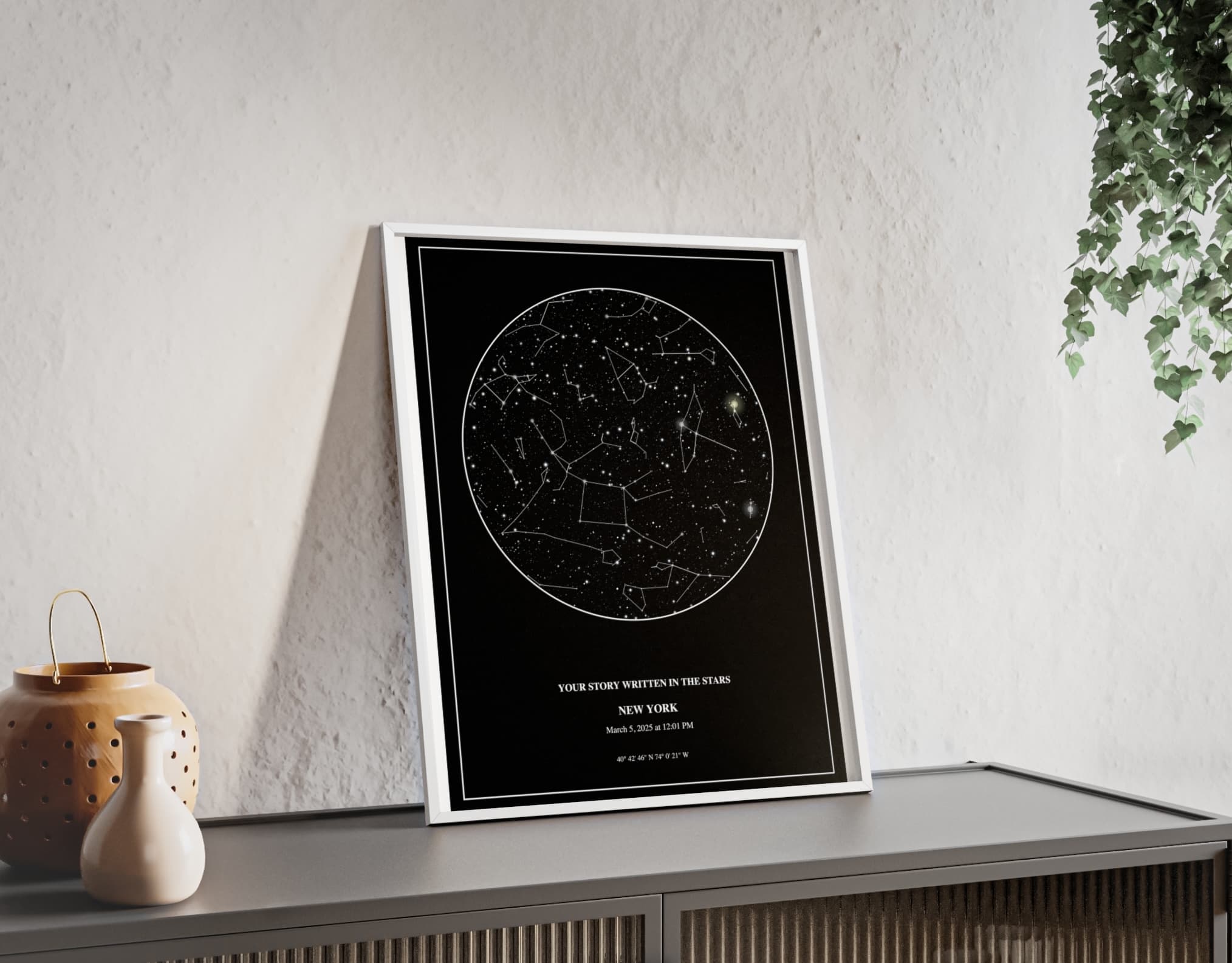
How to Analyze the Sky
Your Beginner's Guide to Stargazing
Learn how to analyze the sky like a pro with our beginner's guide. Discover constellations, planets, and more. Perfect for spring gifts! Get your personalized star chart today.
Astronomy PhD candidate developing balloon-borne VLBI telescopes for black hole research. · March 6, 2026
There’s a profound magic in gazing up at the vast, star-studded canvas of the night. It connects us to something ancient, immense, and incredibly personal. But what if you could move beyond simply admiring its beauty and truly understand what you're seeing? Learning how to analyze the sky isn't just about identifying dots of light; it's about unlocking stories, tracking celestial journeys, and feeling a deeper connection to the universe itself. Imagine being able to point out the North Star, trace the path of a distant planet, or identify the constellations that watched over a truly special moment in your life.
See Your Birth Night Sky Right Now
Enter your birth date and location — your exact sky appears instantly, free.
Free instant preview · From $19.99 if you want to keep it
At Gift The Stars, we believe everyone deserves to experience this connection. Our mission, championed by our founder Mayukh Bagchi, a PhD astronomy student, is to bring the wonder of the cosmos down to Earth, making it accessible and deeply meaningful for you. This guide is your first step towards becoming a confident stargazing enthusiast, ready to explore the heavens with new eyes.
Why Learn How to Analyze the Sky?
The night sky is a living, breathing tapestry that changes with the seasons, the hours, and your location. Learning how to analyze the night sky isn't just a fun hobby; it’s a way to cultivate mindfulness and appreciation for the natural world far above us. It offers a unique perspective, reminding us of our place in the grand cosmic dance. For centuries, humans have looked to the stars for navigation, storytelling, and inspiration. By understanding the patterns and movements above, you're not just observing; you're participating in a timeless tradition.
Perhaps you're looking for a new, enriching activity to share with loved ones, or a peaceful escape from the everyday. Knowing how to interpret the celestial sphere allows you to connect specific memories to the cosmos – like the stars that shone on your wedding night, the day your child was born, or a milestone anniversary. This knowledge deepens the significance of those moments, making them even more unforgettable. It’s also a perfect activity for spring evenings, as the weather warms and the skies beckon.
Essential Tools & Tips for Analyzing the Night Sky
You might think analyzing the night sky requires expensive telescopes and complex equipment, but that's simply not true! Your most powerful tools are already with you: your eyes and a sense of wonder. Here’s what else will help you get started:
- A Dark Sky: Light pollution is the biggest enemy of stargazing. Seek out locations away from city lights. National parks, rural areas, or even your backyard on a moonless night can be great.
- Patience & Adaptation: Give your eyes at least 15-20 minutes to adjust to the darkness. This allows your pupils to dilate and reveal fainter stars.
- A Red-Light Flashlight: White light ruins your night vision. A flashlight with a red filter lets you read charts or find your way without resetting your eyes.
- Warm Clothing: Even on a mild evening, temperatures can drop. Dress in layers to stay comfortable during long observation sessions.
- Star Chart App or Planisphere: A smartphone app like SkyView Lite or Stellarium Mobile can identify objects in real-time. A traditional planisphere (a rotating star chart) is also excellent and doesn't require batteries.
- Binoculars (Optional): While not strictly necessary for beginners, a good pair of binoculars (7x50 or 10x50 are common) can reveal countless more stars, the moons of Jupiter, and even distant nebulae, making your observations even more rewarding.
Step-by-Step: How to Analyze the Sky for Beginners
Identifying Celestial Objects: From Constellations to Planets
Once you've mastered the basics, you'll be able to identify a variety of celestial objects:
- Constellations: These are patterns of stars that humans have imagined and named for millennia. Start with prominent ones like the Big Dipper, Orion, or Cassiopeia. Apps and star charts are invaluable here, showing you the lines that connect the stars into recognizable shapes.
- Planets: Unlike stars, planets don't twinkle much because they reflect light from the sun, rather than generating their own. They also tend to be brighter and follow a predictable path across the sky called the ecliptic. Jupiter, Saturn, Mars, and Venus are often visible to the naked eye. Your personalized planetary star chart can even show you their exact positions on your chosen date!
- The Moon: Our closest celestial neighbor is easy to spot. Observe its phases throughout the month and notice the craters and features even without a telescope.
- The Milky Way: On truly dark nights, you might see a faint, hazy band stretching across the sky. This is the Milky Way, our home galaxy, a breathtaking sight that truly puts our place in the cosmos into perspective.
Remember, every night sky is unique, just like every special moment in your life. With Gift The Stars, you can capture that one-of-a-kind celestial alignment forever. Our star maps are astronomically accurate, created using precise data to show the stars exactly as they appeared from any location and on any date you choose – whether it's the day you met your partner or the birth of a child. It's a truly personal way to remember the wonder of the cosmos and the moments that matter most.
Frequently Asked Questions
What is the best way to analyze the night sky?
The best way to analyze the night sky is to find a dark location away from light pollution, allow your eyes to adjust for 15-20 minutes, and use a reliable star chart app or a physical planisphere to identify constellations, planets, and other celestial objects. Patience and consistent observation are key.
What equipment do I need to analyze the sky?
For beginners, minimal equipment is needed: just your eyes, a dark sky, and perhaps a red-light flashlight. A smartphone app or a planisphere is highly recommended for identification. Binoculars can enhance your view, but a telescope is not necessary to start.
How can I identify constellations easily?
To identify constellations easily, start with well-known ones like the Big Dipper or Orion. Use a star chart app that overlays constellations onto your view of the sky, or a physical star map. Look for bright 'pointer stars' to guide you to other constellations. With practice, you'll start recognizing patterns naturally.
Can I analyze the sky without a telescope?
Absolutely! You can analyze and appreciate a vast amount of the night sky with just your naked eyes. Many constellations, planets (like Venus, Mars, Jupiter, and Saturn), the Moon, and even the Milky Way are visible without any optical aid. A telescope enhances the view but isn't a prerequisite for stargazing.
Create Your Own Star Chart
Capture the exact night sky from any date and place that matters to you.
Create Your Star ChartFrom $19.99 · Instant digital delivery · 326+ 5-star reviews